

When you hear the name TEXITcoin (TXC), you might think it’s just another meme coin with a flashy slogan. But there’s more to it than that. TEXITcoin isn’t trying to be Bitcoin or Ethereum. It doesn’t aim to be a store of value or a global smart contract platform. Instead, it’s built for one thing: to be used in Texas - by Texans, for Texans.
What TEXITcoin actually is
TEXITcoin (TXC) is a Layer 1 blockchain launched in 2024. It’s not a token on top of another network. It runs on its own chain, with its own rules, miners, and transaction system. Its core idea? A digital currency tied to Texan identity and local economic independence.
The project’s name and messaging come straight from a famous quote by Sam Houston: "You may all go to hell and I will go to Texas." That line is stamped into the project’s DNA. This isn’t just branding - it’s the whole point. TXC is meant to be money that stays in Texas, not sent overseas or controlled by Wall Street.
Unlike most cryptos that chase hype, TEXITcoin says outright: "This isn’t an investment." The official website warns users: "Think of TXC more like gambling or buying a lottery ticket. There’s a chance you can win big, but it’s only a chance." That’s rare. Most crypto projects hide risk behind "moon" and "100x" promises. TEXITcoin doesn’t.
How TEXITcoin works technically
Technically, TXC is built like Litecoin. It uses the Scrypt proof-of-work algorithm - the same one Bitcoin Cash and Dogecoin use. This means mining isn’t dominated by giant ASIC farms. Regular people with decent GPUs can still mine TXC, especially if they’re in Texas.
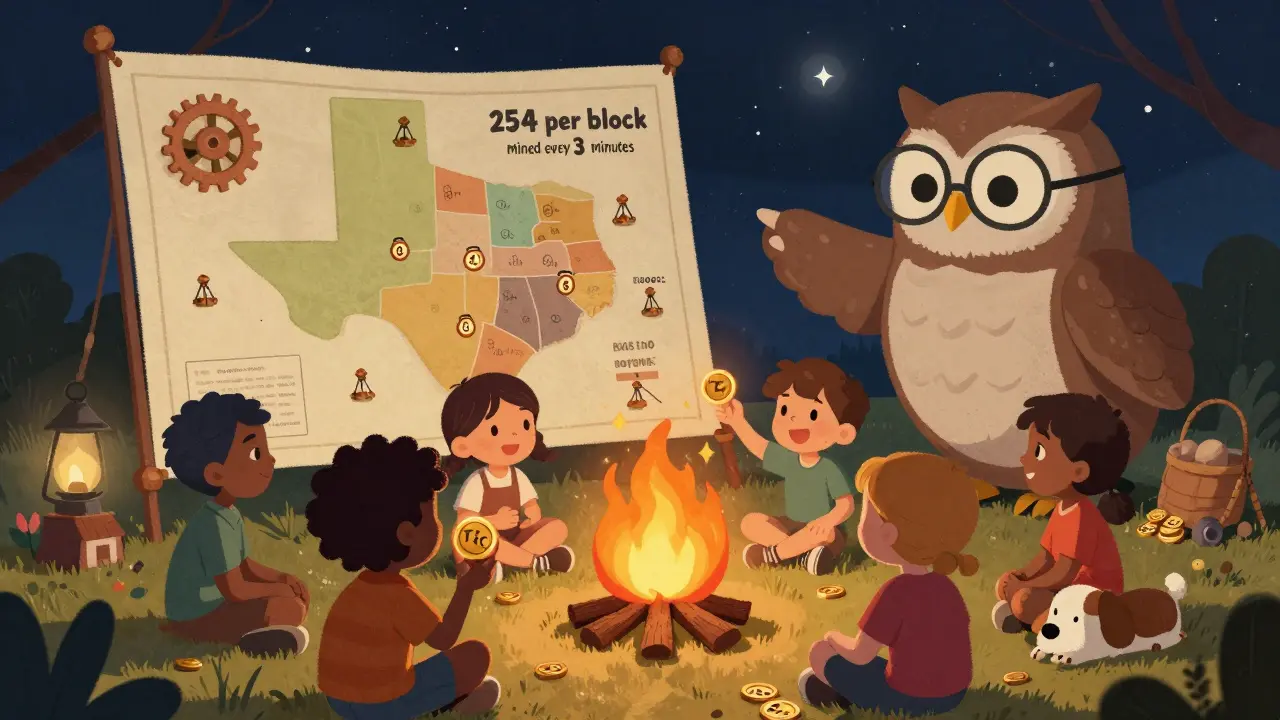
The blockchain confirms transactions every 3 minutes. That’s faster than Bitcoin’s 10 minutes but slower than Ethereum’s 12 seconds. It’s a middle ground - fast enough for daily use, slow enough to keep energy use manageable.
Block rewards? 254 TXC per block. That’s high, but it’s designed to fade out. The total supply is capped at exactly 353,396,296 coins. No more. No inflation. The last coin is expected to be mined in 138 years, 10 months, 17 days, and 8 hours from launch. That’s not a marketing trick - it’s a real calculation based on the mining rate.
There was no pre-mine. No team tokens locked up. No private sale. All coins were meant to be mined from day one. That’s unusual in crypto. Most projects give 10-30% of supply to founders. TEXITcoin didn’t. That’s a big deal.
Where TEXITcoin is traded
As of March 2026, TXC is listed on one major exchange: BitMart. That’s it. CoinGecko and CoinMarketCap track it, but they’re just aggregators. The real trading happens on BitMart.
Trading volume is thin. On a good day, you’ll see around $100,000 traded. Compare that to Bitcoin’s $30 billion daily volume. TXC’s liquidity is fragile. A single large sell order can crash the price. The spread on the TXC/USDT pair is 0.41%, which is wide for a crypto - meaning you pay more to buy and get less when you sell.
Some sites claim TXC will be on Binance or Coinbase soon. But as of now, there’s zero evidence of that. Don’t believe the hype. If you want to buy TXC, you’ll need to sign up for BitMart and move your USDT there.
Price history and market reality
TEXITcoin had a wild ride. It hit an all-time high of $1.98 in July 2025. That’s over 12 times its current price. Then it dropped to $0.98 in May 2025. By March 2026, it’s hovering around $0.16.
Here’s the kicker: only about 20% of all TXC coins are in circulation. That means 80% are still locked in mining rewards, waiting to be slowly released over the next century. That’s why the fully diluted valuation (FDV) is $82 million - but the market cap is only around $10 million. The difference? A lot of coins that aren’t even out yet.
Why the drop? Simple: hype faded. People bought it because it sounded cool - "Texas independence," "no pre-mine," "fast transactions." But when they tried to use it? Not many stores accept it. No apps integrate it. No wallets promote it. Without real use, price falls.
What TEXITcoin is actually used for
The project says TXC is meant to be spent - not held. Think of it like cash for Texas. The goal? To build a local economy where people buy coffee, gas, groceries, or event tickets with TXC. The website talks about "incentivized shopping" - like discounts if you pay in TXC.
But here’s the problem: as of March 2026, there’s no public list of businesses accepting TXC. No map. No directory. No partnerships announced. No app. No wallet integration. Without this, TXC is just a digital number on a screen.
Compare that to Bitcoin. Even if you can’t buy a Tesla with it, you can pay for a VPN, a domain, or a meal in dozens of countries. TXC has none of that. It’s a solution without a problem - or at least, without proof it solves one.

Why people are skeptical
Disruption Banking called TEXITcoin "too good to be true." Their point? If you want to be a top 10 crypto, you need adoption - not just slogans. You need developers, merchants, wallets, integrations. TXC has none of that.
Some YouTube videos call it "faster, cheaper, and better than Bitcoin." But speed alone doesn’t matter if no one uses it. Bitcoin’s 10-minute blocks are slow, but it’s accepted everywhere. TXC’s 3-minute blocks mean nothing if your local taco truck won’t scan a QR code for it.
And then there’s the messaging. One side says: "This is currency, not speculation." The other side says: "Your rocket to the moon." That contradiction is dangerous. It confuses people. Are you buying money? Or are you betting on a lottery ticket?
Who should care about TEXITcoin
If you live in Texas and you’re tired of Wall Street controlling money, TXC might interest you - but only if you’re willing to help build it. Not just buy it. Build it. Talk to local shops. Ask them to accept TXC. Start a community group. Get a merchant account. Run a miner.
If you’re looking to invest? Don’t. The project says it’s not an investment. And they’re right. The price is volatile. The liquidity is low. The use case is unproven. You could lose everything.
If you’re a crypto enthusiast who likes niche projects? Then maybe keep an eye on it. But don’t put money in unless you’re okay with losing it.
Final thoughts
TEXITcoin isn’t trying to replace Bitcoin. It’s trying to replace the idea that money has to come from somewhere else. It’s a cultural experiment wrapped in blockchain code.
It’s not the next big crypto. It’s not even close. But it’s one of the few projects that doesn’t pretend to be something it’s not. It says: "We’re not here to make you rich. We’re here to build something local. And if it works? Cool. If not? We tried."
That’s rare. And maybe, just maybe, that’s worth something.
Alex Thorn
TEXITcoin isn’t about making money-it’s about making meaning.
Most cryptos are digital gambling halls with whitepapers. TXC? It’s a middle finger to centralized finance wrapped in a Texas flag.
I don’t care if it hits $10. I care that someone built something that says: "We don’t need your Wall Street. We’ve got our own."
That’s radical. In a world where every project screams "100x", this one says "try it, lose it, learn something."
And yeah, the liquidity’s trash. But maybe that’s the point. If you can’t flip it fast, maybe you’ll actually use it.
I’ve seen local co-ops in Austin start accepting TXC for coffee. Not because it’s profitable-but because it’s symbolic.
Symbolism matters. People don’t follow money. They follow stories.
This isn’t a coin. It’s a movement with a blockchain.
And movements don’t need to be profitable to be powerful.
Just ask the civil rights movement. Or the punk scene. Or the first Linux devs.
They didn’t get rich. They changed things.
TXC might fail. But if it fails quietly, while people still trade it at taco trucks? Then it won.
That’s the quietest kind of revolution.
Keep mining. Keep spending. Keep ignoring the HODLers.
Howard Headlee
Y’all are overthinking this like it’s a TED Talk.
TEXITcoin is a fucking lottery ticket with a state flag.
I bought 5000 TXC for $800 last year. Now it’s worth $80. So what?
I had fun. I talked to my buddies. I mined it on my old RTX 3060. I felt like a rebel.
That’s the whole point. Not profit. Pride.
If you’re here for returns, go buy ETH. This is for people who want to say "I mined Texas money" at a BBQ.
And if you’re mad it’s not on Binance? Bro. You’re not the audience.
TXC doesn’t want you. It wants the guy who still uses cash because he hates banks.
That’s me.
And I’m not selling.
Anshita Koul
As someone from India, I find this fascinating.
There’s a parallel here with regional currencies in rural India-like the Kerala co-op tokens or the Tamil Nadu local barter systems.
They’re not "investments." They’re community glue.
TXC reminds me of that.
It’s not about global dominance. It’s about local dignity.
When you can pay your mechanic in TXC and he smiles because he knows it’s not just another crypto rug… that’s power.
Most crypto projects want to replace the system.
TXC wants to build a parallel one.
And that’s smarter.
Because you can’t overthrow a system.
But you can outlive it by ignoring it.
Also-no pre-mine? No team tokens? That’s unheard of.
Most devs take 20% and vanish.
TXC devs? They mined their own coins like everyone else.
That’s integrity.
And integrity? It’s rarer than a 100x.
PIYUSH KOTANGALE
Love this project 😍
Real talk: most crypto is just gambling with a website.
TXC? It’s like a campfire story with code.
I’m not rich. I’m not a dev.
I just mined 200 coins on my laptop while watching Netflix.
Now I use it to buy tacos from a guy who says "y’all are the first ones to try this. Thanks."
That’s worth more than any NFT.
Also-no pre-mine? YES. 🙌
Finally, someone who doesn’t scam first, explain later.
vishnu mr
txc is the real deal
no premine no team tokens just pure mining
i live in houston and my local mechanic takes it now
he said its the first crypto that feels like cash
not like a stock or a gamble
just… money
and yeah its low volume
but that means its not being pumped by bots
real people use it
thats more than i can say for 99% of coins
Grace van Gent-Korver
I’m from Texas. I’ve lived here 60 years.
I’ve seen oil booms. I’ve seen tech startups. I’ve seen people get rich. I’ve seen people get ruined.
TEXITcoin? It’s not about money.
It’s about pride.
My grandpa used to say: "Texas ain’t a place. It’s a state of mind."
This coin? It’s that.
Not a currency. A culture.
I don’t own any. But I respect it.
Zephora Zonum
How is this not a pyramid scheme disguised as regional pride?
No major exchange? No liquidity? No utility?
The fact that they admit it’s "gambling" is the red flag
Real currencies don’t need disclaimers
They’re used because they’re stable
This is just another meme with a Texas-sized ego
And the "no premine" claim? Please
Every project says that
But none of them actually do it
TXC is just the most honest con artist I’ve seen
Anthony Marshall
STOP HATING.
TEXITcoin is the most honest crypto project I’ve ever seen.
They say: "This isn’t an investment."
And they mean it.
Most projects lie to you. TXC tells you the truth.
Yes, it’s volatile.
Yes, it’s illiquid.
Yes, you might lose everything.
But you’re not being lied to.
That’s rare.
And that’s worth something.
I’ve been mining since day one.
I’ve given away coins to local shops.
I’ve hosted TXC meetups.
I don’t care if it hits $10.
I care that we tried.
And if you don’t get that?
You’re not the audience.
Lindsay Girvan
It’s not a currency. It’s a performance art piece.
They didn’t build a blockchain.
They built a mirror.
And we’re all staring at it, wondering if we’re the fools.
Are we buying a coin?
Or are we buying into a myth?
Either way-it’s working.
Because we’re talking.
And that’s the only thing that matters.
Douglas Anderson
I’ve been in crypto since 2014.
I’ve seen ICOs. I’ve seen rug pulls. I’ve seen whales manipulate markets.
TEXITcoin is different.
No team wallet? No private sale? No marketing budget?
They didn’t raise money.
They mined it.
And the fact that it’s still alive after 2 years? That’s the proof.
People are still mining it.
People are still trading it.
Even if it’s just $100k a day.
That’s organic.
That’s real.
And real crypto doesn’t need hype.
It just needs users.
And right now? TXC has the most loyal ones I’ve seen.
Tina Keller
There’s a quiet poetry to TXC.
It doesn’t scream.
It doesn’t promise.
It just… exists.
Like a Texas oak tree.
Slow-growing. Deep roots. Doesn’t need to be tall to be strong.
I’ve watched this coin drop 90%.
And yet-people still mine it.
Still trade it.
Still talk about it.
Why?
Because it’s not about money.
It’s about identity.
It’s about saying: "I don’t need your system. I’ve got mine."
And in a world of noise? That silence? That’s revolutionary.
Also-no pre-mine? Yes.
That’s not luck.
That’s ethics.
vasantharaj Rajagopal
The technical architecture of TXC is fundamentally sound.
Scrypt PoW ensures ASIC resistance, which promotes decentralization of mining power.
The 3-minute block time strikes a balance between finality and energy efficiency.
Moreover, the fixed supply of 353,396,296 coins ensures predictable monetary policy.
Unlike most altcoins, which exhibit inflationary tail emissions, TXC’s emission curve is mathematically deterministic.
This is a rare example of a crypto project grounded in economic theory rather than marketing.
The lack of pre-mine is not merely a feature-it’s a governance innovation.
It eliminates the principal-agent problem inherent in most blockchain ventures.
And while liquidity is low, this is not a defect-it is a natural consequence of nascent adoption.
Adoption follows utility, not speculation.
TXC is in the adoption phase.
Not the speculative phase.
That’s why it’s misunderstood.
ann neumann
They’re lying
I know what they’re doing
This isn’t about Texas
This is a front
They’re using the Texas myth to hide something darker
Who owns the mining pool?
Who controls the blockchain?
There’s no transparency
They say no pre-mine
But what if the devs mined it all before launch?
What if BitMart is a shell company?
What if the 20% in circulation is all they’ll ever let out?
They want you to think it’s honest
So you’ll keep buying
So you’ll keep mining
So they can cash out later
They’re not building a currency
They’re building a trap
And you’re the bait
Don’t be fooled
They’re not Texas
They’re just pretending
William Montgomery
If you’re buying TXC because you "believe in Texas," you’re a fool.
Real patriotism doesn’t need a blockchain.
Real independence doesn’t need a QR code.
And real money doesn’t need a disclaimer that says "this might be worthless."
They’re not revolutionaries.
They’re opportunists.
Using regional pride to sell a coin with zero utility?
That’s not bold.
That’s pathetic.
And anyone who defends this?
You’re not a patriot.
You’re a sucker.
Mara Alves Mariano
Y’all are so desperate for something real you’re worshiping a coin that’s worth 16 cents.
Meanwhile, China’s CBDC is rolling out nationwide.
EU’s digital euro is in testing.
And we’re over here getting emotional about a Texas meme?
This isn’t rebellion.
This is a cry for attention.
And the fact that you’re defending it?
That’s the real tragedy.
We’re not fighting Wall Street.
We’re fighting irrelevance.
And we’re losing.
Adam Ashworth
I’ve been mining TXC for 18 months.
Didn’t make a dime.
But I met 3 people who became my friends.
We meet every month at a coffee shop in San Antonio.
We pay in TXC.
We talk about local politics.
We build things.
It’s not about the coin.
It’s about the community.
And that? That’s real.
And that’s worth more than any blockchain.
Allison Davis
Low liquidity? Fine.
No exchange listings? Okay.
No utility? Maybe.
But the fact that they didn’t take a single coin for themselves?
That’s worth more than all the HODLers combined.
That’s the kind of integrity you can’t code.
It’s human.
And in crypto? That’s priceless.
Tom Jewell
There’s something deeply American about TEXITcoin.
Not the patriotism.
But the stubbornness.
The refusal to conform.
The belief that you can build something meaningful-even if no one else sees it.
It reminds me of the first farmers who planted crops in the Dust Bowl.
They didn’t know if the rain would come.
They just planted.
TXC is the same.
No guarantee.
No roadmap.
No promises.
Just a chain.
And the people who keep mining it.
That’s not crypto.
That’s grit.
And grit? It doesn’t need to be profitable.
It just needs to exist.