
Buying a cryptocurrency named after a dairy product sounds like a joke. For many investors in the early days of 2024, it was exactly that-a quick gamble on a trending meme. But if you are reading this in mid-2026, the reality of CHEESE is far less humorous and significantly more complex. The token has survived a brutal market cycle, dropping over 99% from its peak, yet it still trades on major platforms. Why does it exist? Is there any utility behind the name? And more importantly, should you touch it with a ten-foot pole?
This guide cuts through the noise. We will look at the hard data: supply mechanics, price discrepancies across exchanges, and the real risks involved in holding a low-liquidity asset. You won't find hype here. You will find facts.
The Basics: What Actually Is CHEESE?
Cheese (CHEESE) is a speculative cryptocurrency token often categorized as a meme coin or novelty asset within the digital ecosystem. It does not appear to have a robust underlying technology stack, decentralized application (dApp), or significant real-world utility compared to infrastructure coins like Ethereum or Solana. Instead, its value proposition relies entirely on community sentiment, brand recognition, and speculative trading volume.
The token operates with a fixed supply model. According to most major tracking platforms, including CoinStats and LiveCoinWatch, the circulating supply is capped at 1 billion tokens, which is also the maximum supply. This means there is no inflationary pressure from new minting; the total number of CHEESE tokens will never exceed one billion. However, confusion exists because some aggregators, like CoinMarketCap, track a variant called "Cheesecoin" with a different supply metric (around 408 million). This discrepancy suggests either multiple versions of the token exist on different blockchains or data aggregation errors persist across platforms.
Unlike Bitcoin, which is mined through energy-intensive proof-of-work, or Ethereum, which uses proof-of-stake validators, CHEESE's distribution history is murky. Some sources indicate it is "mineable," but without a clear whitepaper or technical documentation detailing the mining algorithm, this claim remains unverified by independent audits. For the average user, this lack of transparency is a red flag.
Price Chaos: Why Does CHEESE Cost Different Things Everywhere?
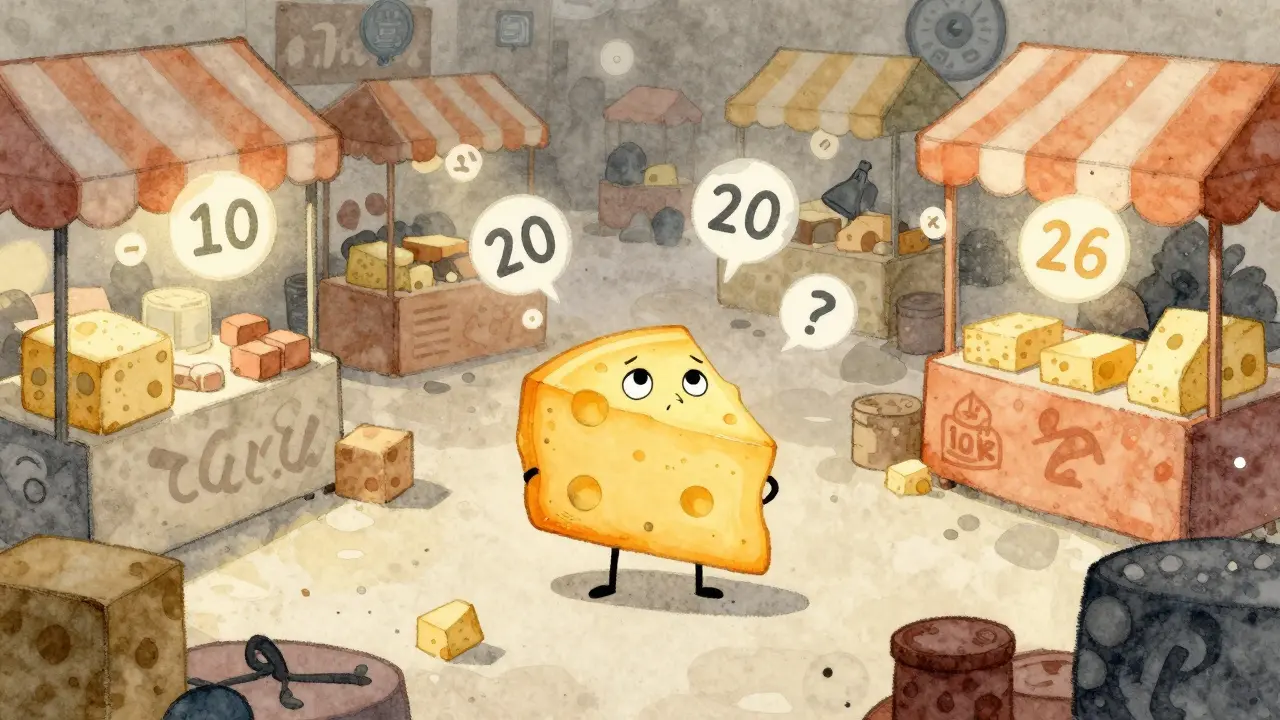
If you check the price of CHEESE today, June 2026, you might get three completely different answers depending on which website you visit. This is not a glitch; it is a symptom of low liquidity and fragmented markets.
- CoinGecko: Reports a price of approximately $0.0000359 with negligible 24-hour volume ($4.39).
- CoinStats: Shows a higher price of $0.000248 with slightly better volume ($814.64).
- LiveCoinWatch: Lists it around $0.000224.
- CoinMarketCap: Tracks a variant at $0.0001696.
Why such a massive gap? In healthy markets, arbitrage bots instantly close these gaps. If CHEESE costs $0.00003 on Exchange A and $0.00024 on Exchange B, traders would buy on A and sell on B until prices equalize. The fact that they don't means there isn't enough trading activity to support arbitrage. This indicates that CHEESE is traded on small, illiquid pairs where large orders can crash the price instantly.
| Platform | Reported Price (USD) | 24h Volume (USD) | Market Cap Rank |
|---|---|---|---|
| CoinGecko | $0.0000359 | $4.39 | #5883 |
| CoinStats | $0.000248 | $814.64 | N/A |
| LiveCoinWatch | $0.000224 | Low | #4556 |
| CoinMarketCap | $0.0001696 | Varies | N/A |
This fragmentation makes it difficult to determine the "true" market value. It also creates risk for buyers who might purchase at a premium on one exchange only to find they cannot sell at that same price on another.
The Fall from Grace: Historical Performance
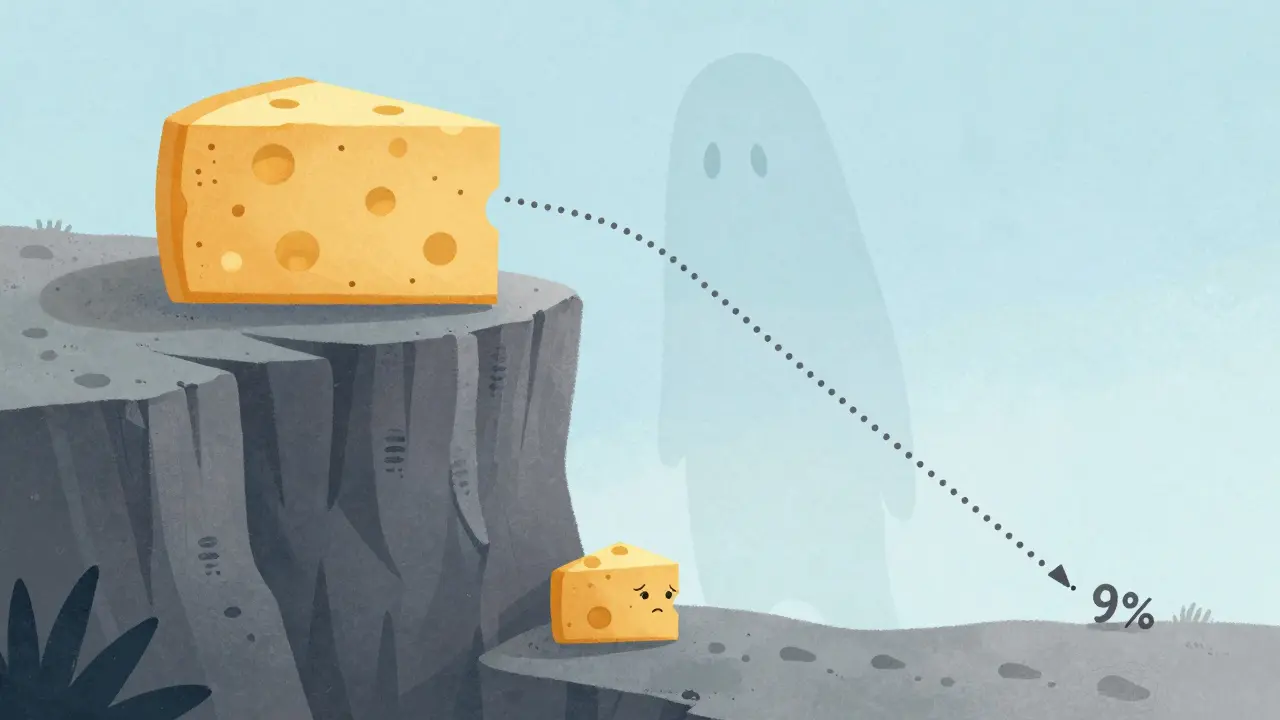
To understand the risk profile of CHEESE, you have to look at its history. The token had its moment in the sun during the summer of 2024. On June 3, 2024, CHEESE reached an all-time high (ATH) of $0.02691.
That was two years ago. Since then, the price has collapsed. As of mid-2026, the token is trading roughly 99.1% below its peak. That is not a correction; that is a capitulation. Only a tiny fraction of the original value remains.
The lowest point came recently, on June 5, 2025, when it hit an all-time low (ATL) of $0.0002199. Currently, it sits just 9.1% above that rock bottom. This trajectory illustrates the classic "pump and dump" lifecycle often seen in meme coins: rapid adoption driven by social media hype, followed by a slow bleed as interest fades and holders exit.
Despite the devastation, the token hasn't gone to zero. It maintains a small base of approximately 4,780 holders according to CoinMarketCap. These are likely long-term believers or accidental holders who forgot about their wallets. But a holder count of under 5,000 is insignificant in the crypto world, where top projects have millions.
Where Can You Trade CHEESE?
Accessibility is one of the few positives for CHEESE. It is listed on several reputable exchanges, which provides a layer of legitimacy. If a project is truly scammy, it usually disappears from major platforms quickly. CHEESE has stuck around.
You can find CHEESE trading pairs on:
- MEXC: One of the primary venues for lower-cap altcoins. MEXC lists CHEESE with basic tokenomics info.
- BC.Game: A crypto-focused gambling and trading platform.
- Other DEXs/CEXs: Various smaller centralized and decentralized exchanges list the token, contributing to the price fragmentation mentioned earlier.
However, being listed doesn't mean it's liquid. On MEXC, for example, the order book depth is shallow. Trying to buy $1,000 worth of CHEESE could slip the price significantly, meaning you pay much more per token than the displayed market price. Always use limit orders, not market orders, when trading assets with low volume.

Risk Assessment: Should You Buy?
Let’s be direct. CHEESE is a high-risk, speculative asset. It lacks fundamental value drivers such as revenue generation, active development teams, or technological innovation. Its primary driver is narrative-specifically, the enduring appeal of cheese-themed memes in internet culture.
Here are the critical risks you need to consider:
- Liquidity Risk: With daily volumes often under $1,000, exiting a position quickly is difficult. You may be forced to accept a bad price.
- Volatility Risk: The 99% drop from ATH shows how fragile the price structure is. Another 90% drop is statistically probable in a bear market.
- Data Integrity Risk: Conflicting supply numbers and prices across aggregators make it hard to do proper due diligence. Are you buying the right token? Is the contract address verified?
- Opportunity Cost: Money tied up in CHEESE is money not invested in assets with clearer growth trajectories, like established Layer 1 blockchains or DeFi protocols.
There is no official whitepaper available that outlines a roadmap for 2026 or beyond. Without a development team actively building features or partnerships, the token relies solely on community goodwill. That is a weak foundation for long-term investment.
Future Outlook: What Comes Next?
Predictions for CHEESE are scarce and largely unreliable. BeInCrypto hosts prediction pages extending to 2030, but these are often algorithmic guesses based on historical patterns rather than fundamental analysis. Given the current bearish trend indicated by MACD indicators on weekly charts, the technical outlook remains negative.
For CHEESE to recover, it would need a catalyst. This could be:
- A viral resurgence of cheese-related memes on TikTok or X (Twitter).
- Integration into a larger gaming or NFT ecosystem that adopts the token as a currency.
- A broader bull run in the crypto market that lifts all boats, including speculative ones.
Without one of these events, the most likely scenario is continued stagnation or slow decline. The token has shown resilience by surviving since 2024, but survival is not success. It simply means it hasn't died yet.
Is CHEESE crypto a good investment in 2026?
No, CHEESE is not considered a sound investment due to its extreme volatility, lack of utility, and 99% decline from its all-time high. It is highly speculative and suitable only for those willing to lose their entire capital.
What is the maximum supply of CHEESE tokens?
Most sources report a maximum and circulating supply of 1 billion CHEESE tokens. However, some platforms track variants with different supplies, so verify the specific contract address before buying.
Why is the price of CHEESE different on CoinGecko vs CoinStats?
The price differences stem from low liquidity and fragmented trading across multiple exchanges. Arbitrage bots cannot easily correct these gaps due to insufficient trading volume, leading to inconsistent pricing data.
Can I mine CHEESE tokens?
Some sources claim CHEESE is mineable, but there is no transparent technical documentation or whitepaper confirming the mining algorithm. Proceed with caution and verify the source of any mining software.
Where can I buy CHEESE crypto?
CHEESE is traded on exchanges like MEXC and BC.Game. Always use limit orders due to low liquidity, and ensure you are buying the correct token contract to avoid scams.