
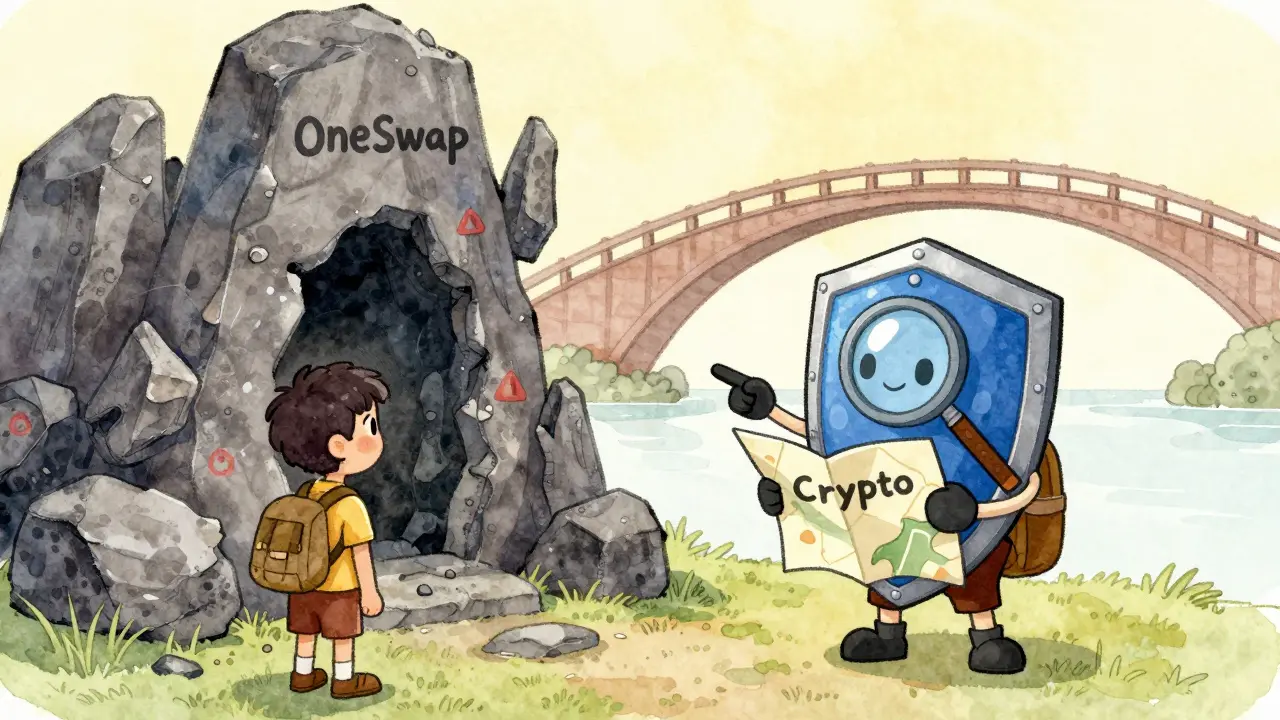
There is a major problem with your search. "OneSwap" does not exist as a reputable, standalone cryptocurrency exchange in the current market landscape of 2026. If you are looking for a platform named specifically "OneSwap," you are likely facing one of two scenarios: either it is a brand-new, unverified project with high scam risk, or you are confusing it with **Uniswap**, the industry-standard decentralized exchange (DEX) that dominates the sector.
In this review, we will address the reality of "OneSwap" to keep your funds safe, and then provide a comprehensive, expert-level analysis of Uniswap, which is almost certainly the platform you intended to research. We will break down how it works, its costs, security risks, and whether it fits your trading needs in 2026.
The "OneSwap" Warning: Scam Alert or Misnomer?
Before we dive into legitimate trading platforms, we need to clear up the confusion around "OneSwap." In the crypto world, names like OneSwap, SwapOne, or similar variations are frequently used by phishing sites or fraudulent projects designed to steal private keys. As of June 2026, there is no major, audited protocol called OneSwap listed on trusted aggregators like CoinGecko or CoinMarketCap with significant volume or security audits.
- If you found a website called OneSwap: Do not connect your wallet. Check if the URL matches a known official domain. If it looks generic or uses a new top-level domain, assume it is malicious.
- If you meant Uniswap: You are in the right place. Uniswap is the largest DEX by volume and liquidity.
- If you meant a specific new token: Treat it with extreme caution. New tokens often mimic established names to gain trust.
For the rest of this article, we will focus on Uniswap, the leading decentralized exchange protocol built on Ethereum. This is the benchmark against which all other DEXs are measured.
What Is Uniswap? The Core Mechanics
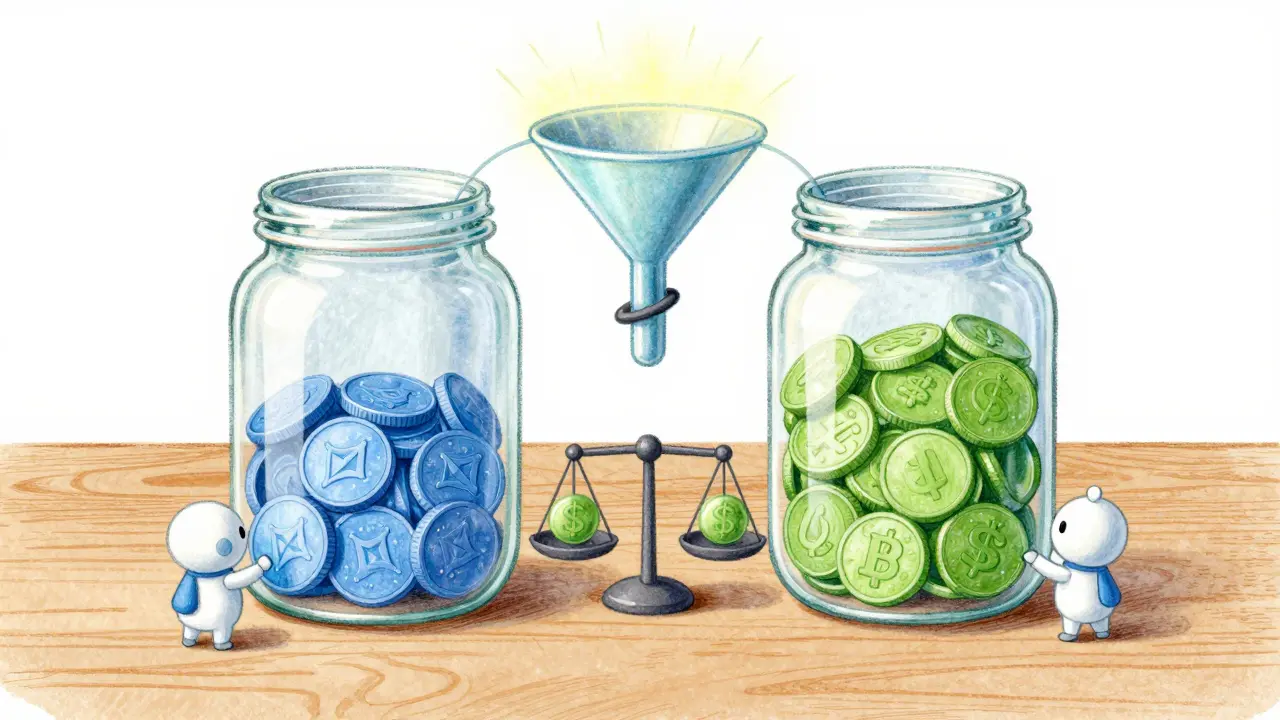
Uniswap is not a company you sign up with. It is a set of smart contracts living on the blockchain. Unlike centralized exchanges like Coinbase or Binance, where a company holds your money and matches buyers with sellers via an order book, Uniswap uses an Automated Market Maker (AMM) model.
Here is how it works in simple terms:
- Liquidity Pools: Users (Liquidity Providers) deposit pairs of tokens, such as ETH and USDC, into a smart contract pool.
- Algorithmic Pricing: The price of a token is determined mathematically based on the ratio of assets in the pool. If someone buys ETH from the pool, the amount of ETH decreases and USDC increases, making ETH more expensive for the next buyer.
- Permissionless Trading: Anyone can swap tokens instantly without approval, KYC (Know Your Customer) checks, or account creation. You only need a Web3 wallet like MetaMask or Trust Wallet.
As of early 2026, Uniswap operates across 38 blockchain networks, including Ethereum, Arbitrum, Optimism, Base, and Polygon. This multi-chain approach allows users to choose lower gas fees while maintaining access to deep liquidity.
Uniswap V4 and V3: Why Version Matters
Understanding the version of Uniswap you are using is critical for cost efficiency and execution quality. The protocol has evolved significantly since its launch in 2018.
| Feature | Uniswap V3 | Uniswap V4 (Current) |
|---|---|---|
| Launch Date | May 2021 | Q4 2025 |
| Liquidity Model | Concentrated Liquidity (LPs pick price ranges) | Concentrated Liquidity + Hooks |
| Customization | Fixed fee tiers (0.05%, 0.3%, 1%) | Dynamic fees via "Hooks" (customizable logic) |
| Trading Interface | Standard swap interface | UniswapX (Intent-based trading) |
| Gas Efficiency | Moderate | High (Batched operations, gasless swaps for users) |
The introduction of Hooks in V4 is a game-changer. Hooks allow developers to customize pool behavior-such as adding limit orders, dynamic fees, or specialized yield strategies-without forking the entire codebase. For traders, this means better prices and more sophisticated trading tools becoming available directly within the Uniswap ecosystem.
Costs: Fees and Gas Explained
When you trade on Uniswap, you pay two types of costs. Understanding these is vital for profitability.
1. Trading Fees
These fees go to the Liquidity Providers (LPs). They vary based on the volatility of the token pair:
- 0.01%: Stablecoin pairs (e.g., USDC/USDT). Low slippage, tight spreads.
- 0.05%: Highly correlated assets (e.g., WBTC/ETH).
- 0.30%: Standard volatile pairs (e.g., ETH/USDC). This is the default for most trades.
- 1.00%: Exotic or highly volatile pairs.
2. Network Gas Fees
This is the payment to blockchain validators. This varies wildly depending on the network you use:
- Ethereum Mainnet: $2.00 - $15.00+ per transaction. Can be prohibitively expensive for small trades.
- Layer 2s (Arbitrum, Optimism, Base): $0.01 - $0.50 per transaction. Highly recommended for daily trading.
Pro Tip: Always switch to a Layer 2 network like Base or Arbitrum unless you specifically need Ethereum mainnet liquidity. The savings are massive.
Security Risks: What You Need to Know
Uniswap itself is secure; its core contracts have been battle-tested for years. However, the user experience introduces significant risks. According to Chainalysis data from late 2025, user-side errors accounted for over 70% of losses associated with DEX interactions.
Common Pitfalls
- Token Approvals: When you swap, you must approve the Uniswap router to spend your tokens. Malicious sites can trick you into approving unlimited spending. Solution: Use Revoke.cash regularly to check and revoke old approvals.
- Phishing Sites: Fake Uniswap websites look identical to the real one. Solution: Only access Uniswap via bookmarked links or verified aggregators like DefiLlama.
- Slippage Settings: Setting slippage too low causes failed transactions. Setting it too high exposes you to MEV (Maximal Extractable Value) bots who front-run your trade for a worse price. Solution: Stick to 0.5% - 1.0% for stable pairs and 1.0% - 2.0% for volatile ones.
Trail of Bits, a leading security firm, confirmed in their December 2025 audit that Uniswap's core protocols remain secure, but warned that the attack surface has shifted entirely to front-end interfaces and user wallet management.

Uniswap vs. Centralized Exchanges (CEX)
Is Uniswap right for you? It depends on your priorities.
| Feature | Uniswap (DEX) | Binance/Coinbase (CEX) |
|---|---|---|
| Custody | otYou hold your keys (Self-custody) | Exchange holds your keys |
| KYC Required | No | Yes |
| Fiat On-Ramp | No (Must buy crypto elsewhere first) | Yes (Credit card, Bank transfer) |
| Liquidity Depth | Deep for major pairs, thin for obscure tokens | Deep for almost all listed tokens |
| User Control | Full control, no frozen accounts | Risk of account suspension |
Choose Uniswap if you value privacy, self-custody, and access to new tokens before they hit centralized exchanges. Choose a CEX if you are a beginner, want to buy directly with dollars/euros, or prefer customer support.
How to Start Trading on Uniswap (Step-by-Step)
If you are ready to proceed, here is the safest way to execute your first trade in 2026.
- Set Up a Wallet: Download MetaMask or Rabby Wallet. Install the browser extension and create a new wallet. Write down your seed phrase offline. Never share it.
- Fund Your Wallet: Buy ETH or the native token of your chosen chain (e.g., ETH for Arbitrum) on a centralized exchange and withdraw it to your wallet address.
- Navigate to Uniswap: Go to
app.uniswap.org. Verify the URL carefully. - Connect Wallet: Click "Connect Wallet" and select your provider. Sign the connection request.
- Select Network: Choose a Layer 2 like Arbitrum or Base for low fees. Ensure you have the native gas token for that chain in your wallet.
- Configure Swap: Select the token you want to sell and the token you want to buy. Adjust slippage tolerance if needed (default is usually fine).
- Approve and Swap: Click "Swap." You may need to click "Approve" first to allow the contract to access your token. Then confirm the transaction in your wallet.
Final Verdict: Is Uniswap Worth It?
Uniswap remains the gold standard for decentralized trading. With $4.2 billion in Total Value Locked (TVL) and dominance in Ethereum-based volume, it offers unparalleled liquidity and reliability. The transition to V4 and UniswapX has made it faster and cheaper than ever before.
However, it is not for everyone. If you are uncomfortable managing private keys, dealing with gas fees, or researching token contracts, you may find the experience frustrating. But if you prioritize sovereignty, security, and access to the full spectrum of digital assets, Uniswap is the essential tool in your kit.
Remember: There is no "OneSwap" safe haven. Stick to verified protocols like Uniswap, Curve, or SushiSwap, and always verify URLs before connecting your wallet.
Is OneSwap a scam?
It is highly likely. There is no major, reputable crypto exchange named "OneSwap" in 2026. Names like this are often used by phishing sites to impersonate legitimate services like Uniswap. Always verify the official website URL and never connect your wallet to unverified domains.
What is the best network to use on Uniswap?
For most users, Layer 2 networks like Arbitrum, Optimism, or Base are the best choice. They offer near-instant transactions and fees under $0.10, compared to Ethereum mainnet fees which can exceed $10.00 during peak times.
Do I need KYC to use Uniswap?
No. Uniswap is a non-custodial, permissionless protocol. You do not need to provide identification, email, or phone number. You only need a Web3 wallet.
How do I avoid losing money to bad slippage?
Set your slippage tolerance appropriately. For stablecoins, 0.5% is usually sufficient. For volatile tokens, 1.0% to 2.0% may be necessary. Avoid setting it higher than 5% unless you are trading extremely illiquid assets, as this exposes you to front-running bots.
Can I recover my funds if I send them to the wrong address on Uniswap?
No. Blockchain transactions are irreversible. Since Uniswap is decentralized, there is no customer support team to reverse transactions. Always double-check recipient addresses and contract interactions before signing.
dan kaffeman
Look, if you cant even spell the name of the biggest DEX in America right then you dont deserve to hold any crypto at all. Uniswap is built by Americans and its the standard because we lead the innovation game. Stop looking for some sketchy off-shore scam called OneSwap and stick to what works. The rest of you are just leeching off real traders who know better.
Sylvia Mossman
Oh please, spare me the patriotic nonsense. Just because it launched on Ethereum doesnt make it American property. Its code is open source and global. Youre acting like a jealous kid watching someone else play with their toys. Also your spelling is atrocious.
Meg Gran
i mean honestly who cares about national pride when talking about smart contracts? they dont have passports lol. but yeah one swap sounds sus af. always check the url guys. i almost got drained last week cause i clicked a bad ad on twitter so now im paranoid as hell.
verna kennedy
You clearly do not understand the gravity of security in decentralized finance. It is not a joke. Using unverified platforms is negligence. I expect people to read the documentation thoroughly before risking their capital. Your casual attitude towards phishing attempts is frankly disturbing and irresponsible for anyone claiming to be an investor.
Lee Paige
The whole concept of these centralized narratives controlling the narrative around 'safe' exchanges is a lie. They want you on Uniswap because they can track the wallet clusters through blockchain analysis firms that sell data to the SEC. There is no privacy here. Only surveillance capitalism disguised as decentralization. Wake up.
Madhu Menon
Perhaps the true philosophy lies in the act of verification itself. We must question every link, every contract address. It is a meditative practice of caution. 🧘♂️
Yogendra Dwivedi
I found this breakdown of V4 hooks very useful. It clarifies why gas efficiency has improved significantly compared to previous versions. For those new to Layer 2s, switching to Arbitrum or Base is indeed the most logical step to reduce transaction costs without sacrificing security.
Karthikeyan S
bro u r missing the point entirely 😡 the fees are still too high for small holders like us in india. why should we pay more than westerners just to trade? its unfair system designed to keep us poor. stop pretending its equal when it isnt 📉💸
Narendra Kulkarni
Hey there, no need to get upset. The gas fees on L2s are actually quite low for everyone globally, usually under a dollar. Maybe try using Base chain next time, it might help with the cost issue. Hope things work out for you!
Alexis Abster
This article is absolutely fantastic! It gives me so much hope for the future of self-custody. Knowing that I can protect my assets from greedy corporations makes me feel empowered and safe. Thank you for writing this, it truly changed my perspective on digital sovereignty!
Brad Ranks
I literally screamed when I read about the slippage settings. I lost so much money front-running bots last year. This guide is a lifesaver. Seriously though, if you don't revoke your approvals regularly you are basically handing your keys to a thief. Do it now.
Greg Lewis
you think revoking approvals saves you? the wallet providers themselves are compromised. meta mask tracks everything. you are playing chess while they own the board. wake up sheeple.
Dinesh Pattigilli
Only idiots use centralized exchanges. If you are reading this and still on binance you are part of the problem. Uniswap V4 is the only way forward for intelligent traders who value their freedom over convenience. Learn to code or get left behind.
Caitlin Donahue
i thnik this post is reallly helpful espically for ppl like me who get confused by all teh tech jargon. thanks for breaking it down so nicely. im gonna try swapping on base network since it seems cheaper. hope i dont mess up my seed phrase lol.
Caralee Robertson
Just wanted to say i really appreciate the warning about OneSwap. I almost clicked a link yesterday that looked legit but had a weird domain extension. Scary how close i came to losing everything. Thanks for keeping us safe out here.
Alexander DeVries
Listen up! You have the power to control your financial destiny through proper education and disciplined trading practices. Do not let fear stop you from exploring decentralized finance. Use the tools provided in this guide to maximize your potential and secure your wealth. Action is key!
Kelly Tenney
It is wonderful to see such a supportive community helping each other stay safe. Remember to take breaks and not stress too much about market fluctuations. Your mental health is just as important as your portfolio balance. Keep learning and growing together.
Mark Corpuz
The distinction between Uniswap V3 and V4 is critical for understanding modern liquidity provision. The introduction of hooks allows for unprecedented customization, which fundamentally alters the economic incentives for liquidity providers. This technological advancement represents a significant leap forward in protocol design efficiency.