

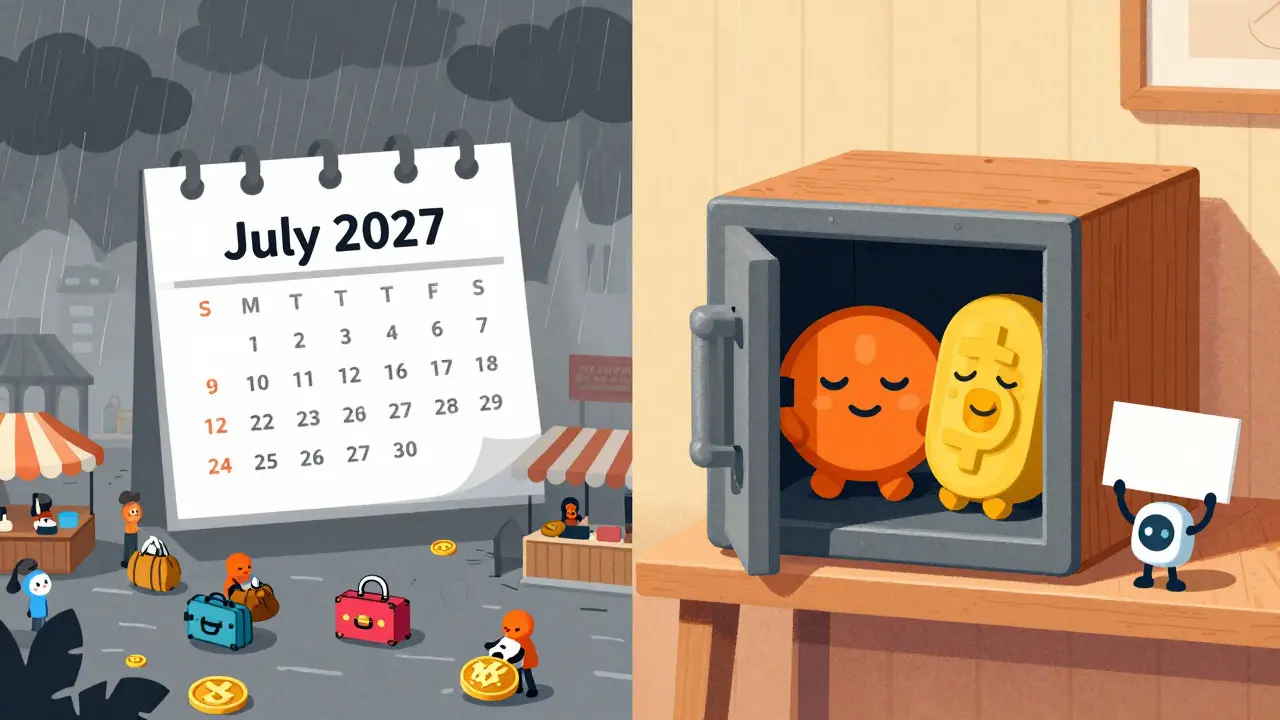
Imagine waking up in July 2027 to find that your favorite private cryptocurrency is no longer tradeable on any major European exchange. For holders of Monero and Zcash, this isn't just a hypothetical scenario-it's a regulatory reality set in stone by the European Union. The EU has finalized legislation that effectively bans these privacy-focused assets from regulated markets starting July 1, 2027. This move stems from Regulation 2024/1624, adopted in May 2024, marking the most aggressive crackdown on financial anonymity in Europe’s history. If you hold XMR or ZEC, or plan to invest in them, understanding exactly what changes and how to navigate this new landscape is critical.
Why the EU Is Banning Privacy Coins
The core driver behind this ban is the fight against money laundering and terrorist financing. Regulators argue that while transparent cryptocurrencies like Bitcoin fit well into standard compliance frameworks due to their traceable ledgers, privacy coins create blind spots. Monero uses ring signatures and stealth addresses to make transactions completely untraceable, whereas Zcash employs zero-knowledge proofs to hide sender, receiver, and amount details. To European lawmakers, these features are not just technical choices but risks that make it "difficult to identify related transactions that might give rise to suspicion." The goal is simple: eliminate tools that facilitate illicit financial activities by forcing all digital asset transactions onto a visible, auditable path.
The Legal Framework: AMLR and MiCA
This restriction isn't a standalone rule; it’s embedded in a broader regulatory package. The primary mechanism is Article 79 of the Anti-Money Laundering Regulation (AMLR). This article explicitly prohibits credit institutions, financial institutions, and crypto-asset service providers (CASPs) from maintaining anonymous accounts or handling privacy-preserving digital assets. It specifically targets "crypto-asset accounts allowing anonymization of transactions" and "accounts using anonymity-enhancing coins." This works in tandem with the Markets in Crypto-Assets (MiCA) regulation, which governs the general operation of crypto firms in the EU. Together, they create a comprehensive framework where CASPs must verify identities for all transfers above €1,000. Since privacy coins are designed to prevent such audit trails, they become incompatible with the legal requirements for doing business in the EU. The European Crypto Initiative (EUCI) has confirmed that centralized projects operating as CASPs under MiCA need to adjust their internal processes now, effectively requiring them to cease privacy coin operations before the deadline.

What Changes for Investors and Exchanges
For most retail investors, the immediate impact will be felt on centralized exchanges. By July 1, 2027, EU-regulated platforms will likely delist Monero and Zcash to avoid penalties. This means you won’t be able to buy, sell, or swap these assets on popular venues like Kraken (EU), Coinbase (EU), or Binance (EU) without risking non-compliance. However, this does not criminalize individual possession. You can still hold your coins, but accessing liquidity through regulated channels becomes impossible. The oversight for this transition falls to a new body called the Anti-Money Laundering Authority (AMLA). AMLA will begin monitoring large crypto firms-specifically those serving tens of thousands of customers or processing over €50 million in transactions. Initially, about 40 major firms will fall under direct supervision. The European Banking Authority is currently finalizing the specific technical standards through public consultations, but the EUCI notes that the "broader framework is final," meaning the core prohibition cannot be reversed.
| Feature | Monero (XMR) | Zcash (ZEC) | Bitcoin (BTC) |
|---|---|---|---|
| Transaction Privacy | Default (Ring Signatures) | Optional (Shielded Pools) | Pseudo-anonymous (Public Ledger) |
| Traceability | Low | Moderate (if transparent tx used) | High |
| EU Status Post-2027 | Banned from Regulated Services | Banned from Regulated Services | Fully Compliant |
| Identity Verification Req. | Incompatible with Default Use | Incompatible with Shielded Use | Compatible (KYC via Exchange) |
Market Implications and Global Ripple Effects
The EU represents one of the world’s largest cryptocurrency markets. Banning privacy coins from regulated services creates a significant market contraction for these assets within the bloc. Traders have already shown mixed reactions, with price volatility spiking as the 2027 deadline approaches. However, the regulation only affects EU-based service providers. This opens the door for regulatory arbitrage, where activity may shift to jurisdictions outside EU control or to decentralized exchanges (DEXs) that don’t require KYC. Industry experts view this development as inevitable. As noted in recent analyses, anonymous cryptocurrencies stand in stark contradiction to standard AML rules. While some critics view financial privacy as a fundamental right, policymakers see it as a necessary step toward cleaning up the crypto space. The long-term viability of privacy coins in major global markets remains uncertain, as other jurisdictions may look to the EU’s comprehensive framework as a template for their own regulations.
How to Prepare Before July 2027
If you hold Monero or Zcash, you have a two-year window to decide your next steps. Here is what you should consider:
- Assess Your Exposure: Determine how much of your portfolio is tied to privacy coins. If it’s a small percentage, the impact may be manageable. If it’s substantial, you might want to diversify earlier rather than later.
- Explore Non-EU Platforms: While EU exchanges will delist, non-EU brokers and offshore platforms may continue to offer these assets. However, keep in mind that using them may involve higher fees, less consumer protection, and potential tax complexities.
- Consider Decentralized Options: DEXs allow you to trade without a central intermediary. However, liquidity for privacy coins on DEXs is often lower than on centralized exchanges, leading to higher slippage during large trades.
- Monitor Regulatory Updates: The European Banking Authority is still finalizing technical details. Keep an eye on official announcements for any clarifications on what constitutes an "anonymity-enhancing coin" or specific exemptions.
Frequently Asked Questions
Is it illegal to hold Monero or Zcash in the EU after 2027?
No, holding privacy coins is not illegal. The ban prevents EU-regulated financial institutions and crypto-asset service providers from offering services involving these assets. Individuals can still own and store them, but trading them on regulated exchanges will no longer be possible.
Which specific regulation causes this ban?
The ban is primarily driven by Article 79 of the EU Anti-Money Laundering Regulation (AMLR), which prohibits anonymous accounts and privacy-preserving digital assets. It works alongside the MiCA regulation to enforce identity verification for all crypto transfers above €1,000.
Will all privacy coins be banned, or just Monero and Zcash?
While Monero and Zcash are the most prominent examples, the regulation targets any "anonymity-enhancing coin." This could include other assets like Dash or future privacy-focused tokens. The exact list may be clarified through European Banking Authority consultations, but the principle applies to any asset that hides transaction details.
Can I still trade privacy coins on decentralized exchanges?
Yes, decentralized exchanges (DEXs) are generally not subject to the same strict KYC and service provider rules as centralized exchanges. However, liquidity may be lower, and users must manage their own security and tax reporting responsibilities carefully.
Who is responsible for enforcing these new rules?
The new Anti-Money Laundering Authority (AMLA) will oversee enforcement, particularly for large firms. The European Banking Authority is also involved in setting the specific technical standards that firms must follow to remain compliant.
Marco Maldonado
EU is killing innovation again. Why do they care about privacy? We have the best economy in the world and we dont need their rules. Just move your money to US exchanges. They are too stupid to understand tech.
Daniel Brown
Actually, if you look at Article 79 of the AMLR, it specifically targets credit institutions and CASPs. It does not ban individual holding. You can still self-custody. The restriction is on the service layer. Most people confuse 'banned from exchange' with 'illegal to own'. Read the text before you panic.
Marco Maldonado
Yeah yeah read the text. But if its not on an exchange who buys it? Price goes to zero. Its over for XMR. EU always kills what is good. America wins.
Rod Sidoroff
Let us be clear: this is not a ban, it is a curation. The market will decide which assets survive. Privacy is a feature, but compliance is a cost. If you cannot afford the cost of compliance, perhaps you should not be in the global financial system. The elites know this. The rest of you are just gambling with other people's money. The separation of church and state is dead, long live the regulator.
Carmene Jackson
ugh so dramatic lol. i just hold my coins in a hardware wallet. who cares what the eu thinks? feels like they are trying to control everything though. annoying as hell.
Rod Sidoroff
Self-custody is easy when you are already wealthy and have the technical knowledge. For the average retail investor, the friction increases. Friction drives out capital. Capital follows liquidity. Liquidity dries up where regulation is heavy. It is simple economics, not drama.
Niall O'Rourke
so basically they are saying privacy is bad right. why would you want to hide your money. its only bad people hiding money. or maybe its just the banks wanting more power. i am sure it has nothing to do with that
Jay Johhnston
It's a bit more nuanced than that. The main concern for regulators is AML and CFT. Money laundering is a real problem. But yes, it often feels like a power play by incumbents. I think it's important to keep both perspectives in mind. The goal is safety, even if the method is heavy-handed.
Niall O'Rourke
safety for whom. for the rich or for the poor. i think its for the banks. they hate competition. always do. just my two cents from ireland
Jillian Groskreutz
Oh, please! Please! Stop acting like this is a surprise. Regulation is coming, whether you like it or not! The era of wild-west crypto is over, and frankly, it's about time! Those who complain are simply lazy investors who didn't do their due diligence. Face the facts, people!
Patrick Quairoli
they are watching you all. the deep state wants your data. monero is the only way to stay free. trust no one. the eu is just a front for the global elite. wake up sheeple. they want to track every satoshi you move. conspiracy is truth.
Jillian Groskreutz
Conspiracy theories aside, the legal text is public! Read it! It says 'anonymity-enhancing coins'. That's specific. It's not about tracking every satoshi, it's about KYC compliance for large transfers. Stop being paranoid and start reading the law! It's right there in black and white!
Zothana Pachuau
Nice take. Though I'd say the 'wild west' days were never really safe for anyone except the whales. Now we get actual rules. It's like traffic lights. You hate them until you see how many cars crash without them. Just saying. 😅
Linda Leeuwesteijn
Absolutely love this analogy! 🚦 Traffic lights make sense. I think most people just need a little more patience with the transition period. It’s going to be a learning curve for everyone, but the end result should be a much healthier market. 💪✨
Shawn Schaerer
One must consider the philosophical implications of such a mandate. Is privacy a right, or is it a privilege granted by the state? The EU argues the latter, citing the social contract. However, the decentralized nature of blockchain suggests a different paradigm entirely. This is not merely a regulatory hurdle; it is a fundamental clash of ideologies regarding sovereignty and autonomy. We stand at a crossroads, and the choice we make now will define the future of digital finance for decades to come.
Hicham Mounir
Wow, that was intense! I feel like we are all just trying to figure this out together. It's scary how fast things change, isn't it? I'm glad we have a community to talk through these big questions. Let's keep supporting each other while we navigate this new landscape. ❤️
Phelan Deihl
I've been thinking about this a lot. It changes how we view ownership. If you can't easily sell it, is it really yours in a practical sense?
Ashley Snyder
Oh, the *drama*! 😂 You think this is the first time a government tried to regulate something? It's not a ban, it's a *delisting*. Big difference. And honestly, if you're relying on centralized exchanges for your freedom, you were never truly free to begin with. Wake up and smell the coffee! ☕
Nia Franklin
totally agree!! i mean... kinda?? it is super confusing tho. i like the idea of privacy but also dont want to get in trouble. maybe we can all just chill and wait for the dust to settle? 🌸✨
Mohamed Shoaeb
Chilling is good. I think the DEX route is the way forward for now. Less headache. Also the price might dip which could be a buying opportunity for those with cold storage. Just my observation.
Sonia Gomez Gomez
You people are so naive. Privacy is for criminals. Period. If you have nothing to hide, why hide it? This ban is just common sense. The EU is saving us from ourselves. Don't fight the wave, ride it. 🙄
SHIV SHANKAR KANTA
privacy is not for criminals it is for humans. the human spirit demands secrecy. the state demands transparency. this is the eternal struggle. the coin is just the vessel. the war is in the minds. let it flow.